
This article was created with thanks to Douwe Bosga and Wim van Utrecht That written I have absolutely no idea what site this was taken from as it was a long time bvack -anyone know please let me know!
As I have noted many times before I believe that so called "UFO Waves" are an invention created by public interest and misreporting what they have seen as well as Ufologists pushing the idea to get more press attention.
Thios case is interesting as it offers a possible(?!) explanation. These are all of the facts I could gather.
_______________________________________________-

1973 was such an eventful year worldwide for humanoid sightings that researcher David Webb dubbed it the "Year of the Humanoids." He even wrote a book of the same name about it. And if you think the Netherlands was spared from that wave of strange encounters with—so beautifully translated at the time— Ufonauts , you're mistaken.
Although we primarily want to focus on the UFO phenomenon with UFO Affairs, I still feel we shouldn't leave the case of Mrs. Dolphijn from Uden undiscussed. As the original founder of UFO Reporting Center Netherlands, I'm very interested in UFO cases from our own country, and since I learned about it, this particular case has stuck with me. A truly Dutch close encounter (CE3) that has captivated me for some time. What follows is a report that has never before been so comprehensively presented.
The observation
Uden, November 10, 1973. Around 2:15 a.m., Ann Dolphijn (55) woke up to use the restroom and walked from the bedroom at the back of the house to the bathroom at the front. On her way, she saw something white out of the corner of her eye from the window but ignored it, as she had more pressing matters to attend to. When Ann returned to bed and walked past the window again, she saw something that now really demanded her attention.

On the sidewalk in front of her house, she saw three small figures in white robes walking toward her house. Ann pressed her nose against the window to try and figure out what she was looking at. The white robes reminded her of a monk's habit: long white robes that reached all the way down to their (proportionally large) shoes. The figures' faces were covered by white hoods that seemed to be attached to the robes and tapered to two points on either side, falling down to their shoulders. Around their waists, they wore belts from which seemingly hung instruments, reflecting in the bright moonlight.
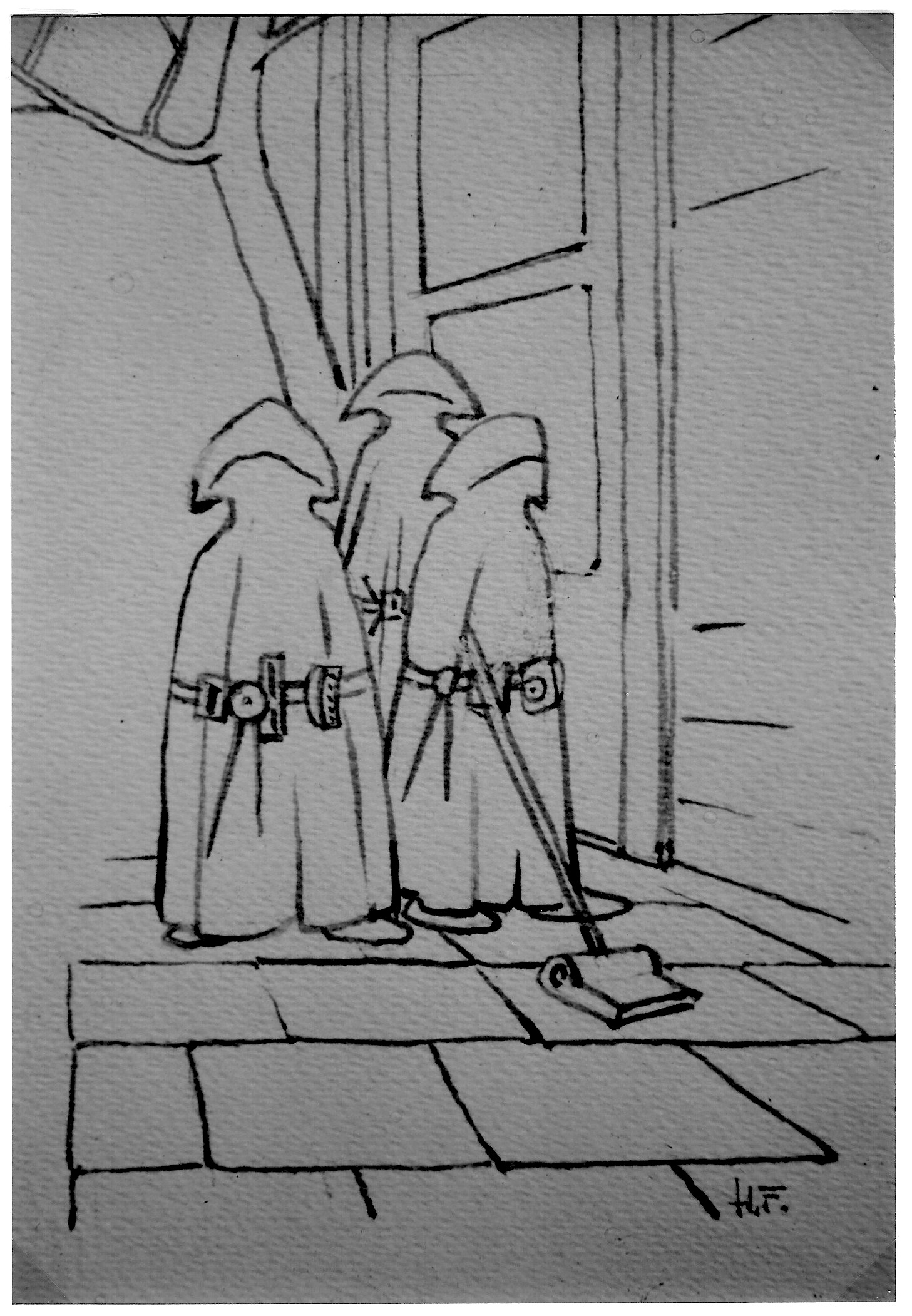
The two front figures, walking side by side, were barely a meter tall, and the one behind them was a bit taller, she guessed. Ann found the way they walked rather odd because their feet didn't leave the ground; they shuffled along very slowly, as if they had no knees. She thought the creatures must have very small legs because they held their legs stiffly as they shuffled, as if they had no knees. One of the front figures held an instrument that could best be described as a carpet sweeper—an old-fashioned kind of vacuum cleaner. As it walked, the figure moved the instrument back and forth across the sidewalk as if it were a metal detector. Ann felt uneasy as she watched the trio from the bathroom window, but didn't want to wake her husband, lest his bad heart be too frightened. She continued quietly watching. About five minutes passed until the front figure looked up and realized someone was watching them. The creature seemed to say something to the others, at which point the group turned, shuffled quickly down the street, and disappeared from view behind a school building. Ann glanced carefully at the street to see if any more unusual scenes were unfolding. To no avail.
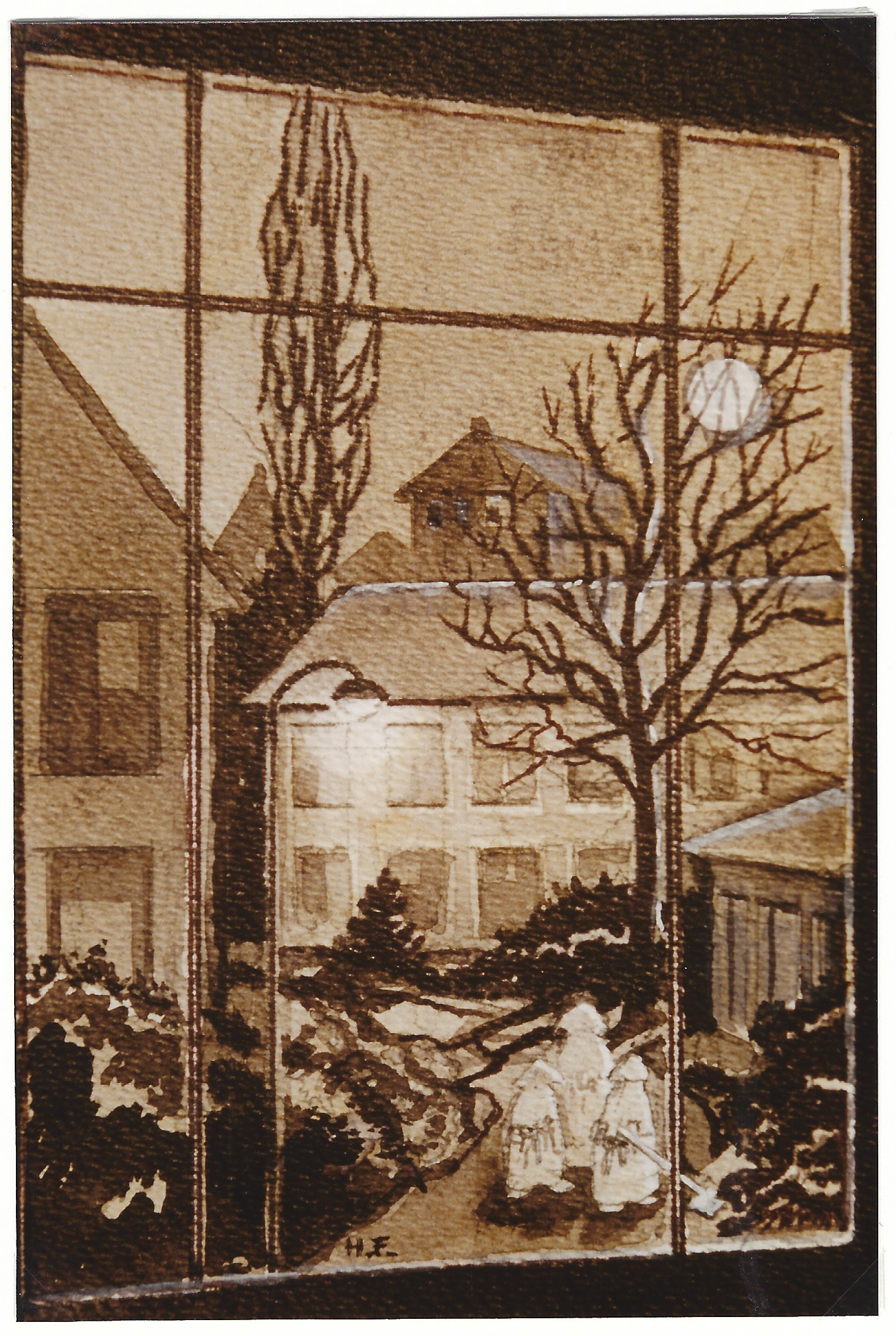
Excited, she rushed back to the bedroom to cautiously inform her husband, but the moment she entered, she saw through the window—which overlooked the backyard and the adjacent street—a glowing red ball hovering just above the sidewalk, about 40 meters away. According to Ann, the ball was two to two and a half meters in diameter and covered the entire width of the sidewalk. The light from the ball reminded her of a setting sun, but so bright that it was impossible to look directly at it.
Her husband, who had woken up in the meantime, asked what time it was, whereupon Ann turned to look at the clock radio. "Five to 2:30," she replied, turning back to the window, where the ball was nowhere to be seen. Distraught, she recounted the entire incident to her husband, from the strange figures in front of the house to the floating ball at the back. After a while, there was nothing left to do but go back to sleep. The next morning, Ann went to the police station to report what she had seen that night, hoping others had reported a similar experience.
From Uden to Illinois and back
When Ann still hadn't received a statement from the police a year later, she decided to share her story with an open acquaintance, Bob Muyen. His son, Edmund, happened to be interested in the UFO phenomenon and found the sighting very important. He passed the story on to the Center for UFO Studies (CUFOS) in Illinois, USA, via an open letter. This was then picked up by CUFOS employee David Webb, who included it in his book, " Year of the Humanoids, " published in 1976. As I mentioned in the introduction, this book is entirely devoted to sightings similar to Ann's, which occurred all over the world in 1973. Remarkable, to say the least, but it doesn't stop there.
Dutch UFO researcher Douwe Bosga, who had just finished a year at CUFOS, returned from America in February 1978. In his final months at CUFOS, he had been heavily involved in close encounters and had read Ann's story in Year of the Humanoids . After returning home, he felt it was high time to investigate the Dutch close encounter .
From March to July, Douwe had several conversations with Ann. The file from these conversations is one of the sources from which we were able to record the above story. We were also able to conclude from that same file that Ann was a very serious, reliable, and accountable witness. She appears to have had no motive whatsoever to fabricate the story and never sought publicity with it.
Thanks to Douwe's investigation, the case finally reached the media five years later, and numerous publications came to Ann's attention. We know from several of the journalists who spoke with her that they, too, never doubted her story or integrity. All this is reason enough for us to believe that Ann saw what she claims. But does this mean we're talking about aliens and a UFO?
Slow down
In 1973 , Hans van Kampen's book "UFOs Over the Low Countries" was also published. In it, he briefly discusses Ann Dolphijn's experience but unfortunately exaggerates the story to discredit the prominent American UFO researcher J. Allen Hynek—who had added the case to his close encounter statistics. Van Kampen writes, for example, that Ann "saw a flying saucer in her garden" and "that the saucer seemed to be manned by small beings in spacesuits, who were busy taking soil samples" and "that at a certain moment the men got in and the UFO disappeared from view in a flash." As far as I'm concerned, this is pure ridicule, or at the very least, a serious exaggeration.
This must have been what Mr. Maas thought when he wrote a letter to the journal of the Study Group for Strange Aerial Phenomena (SVL) in 1984. He needed to vent because he had read the aforementioned passage from Hans van Kampen's book and didn't appreciate the tone. He had followed the case closely all those years and believed that these kinds of files should remain factual, otherwise they would take on a life of their own. He even offered an explanation for Ann's sighting.
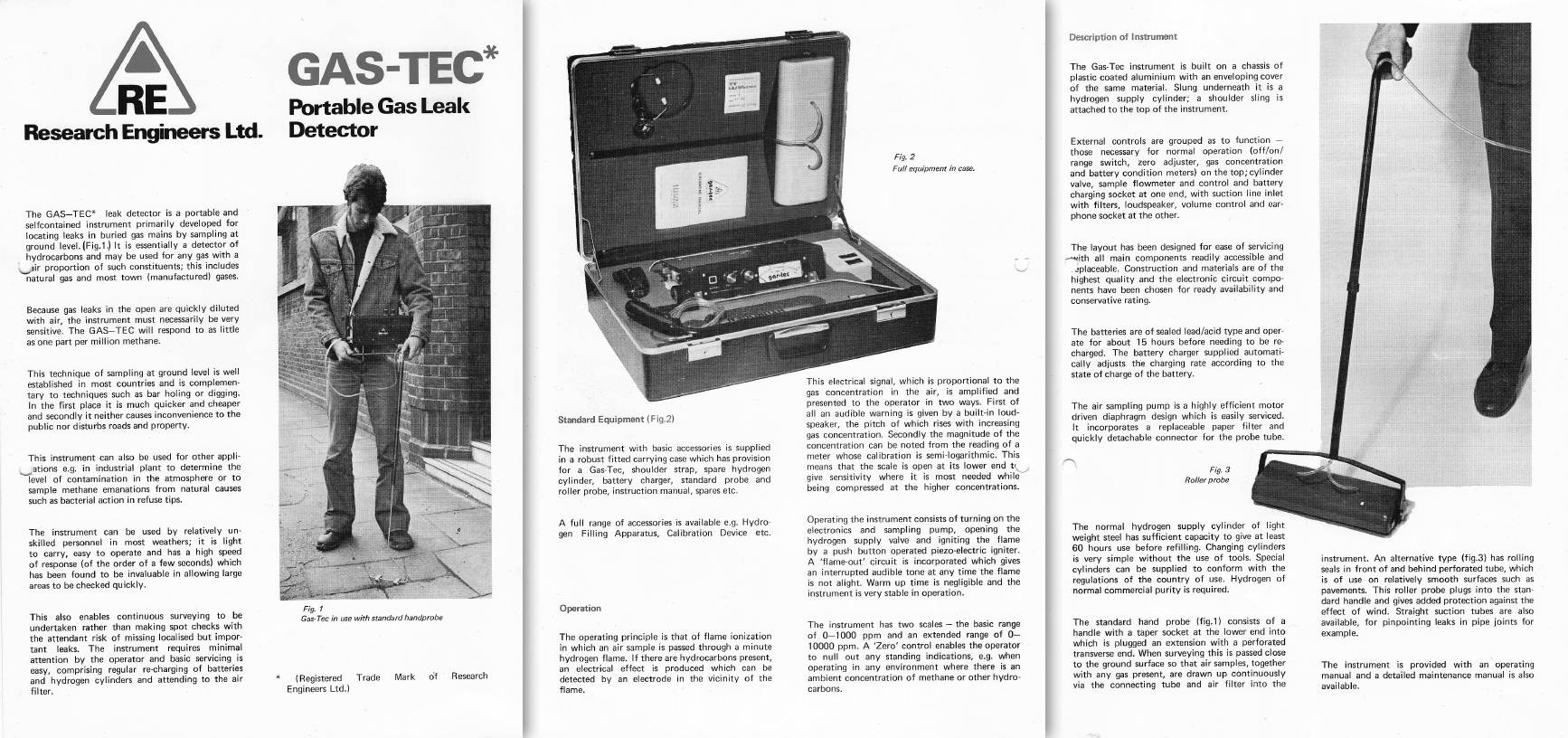
In his letter, Mr. Maas recounts how he once moved to a new neighborhood where the streets weren't all paved yet. One night, a Gasunie van pulled up and several men got out, carrying tools hanging from a belt. They also carried a device resembling a carpet sweeper, just like in Ann's story.
They shuffled across the sand past the houses. When Maas asked them what they were doing, one of the men replied that they were detecting possible gas leaks in the newly installed gas pipes. This had to be done at night because less gas was used then, and therefore there would be more pressure on the pipes, making it easier to detect leaks. The SVL (Socialist Movement of Flanders) did nothing further with this, but another UFO working group, NOBOVO, pursued this possible explanation and contacted regional gas supplier ObraGas.

Unfortunately, it was now 1985, and the company had to admit that all documentation older than 10 years had already been destroyed. Any evidence of a gas leak inspection could therefore neither be ruled out nor confirmed.
I must admit that this explanation is plausible. The time, the tool belt, and the gas detector can all be explained perfectly. But what about the strange clothing, the size of the figures, their odd behavior, and that glowing orb? Maas's explanation didn't address these issues.
Shortly after this article was published, we happened to meet a Stedin employee who was checking the sidewalk for gas leaks with the infamous carpet sweeper. This encounter yielded some new insights. For instance, according to the worker, the carpet sweeper model wasn't yet in use in 1973; back then, they still used the triangle model (left in the GAS-TEC image). He also indicated that, to his knowledge, they never searched for gas leaks at night, although the explanation Maas received in 1984 for doing so at night is certainly plausible. Who knows what changed between 1973 and 1984...

Prince Carnival
In 1980, Hans van Kampen published another UFO book, Spooklicht , and once again Van Kampen tackled the Ann Dolphijn case. This time, the content was much better, as it was now based on the account of Douwe Bosga, who had obtained the story firsthand. Van Kampen now also had an explanation: carnival.
That sounds like Van Kampen is once again going down the path of ridicule, but if you think about it, this claim is at least as valid as the previous one. The eleventh of the eleventh at eleven past eleven is the time that the carnival season begins in the Netherlands. On or around this date, the local Prince Carnival is also honored, which in Brabant can sometimes lead to quite a party. It's conceivable, then, that a trio of costumed partygoers, perhaps intoxicated by a few beers, shuffled through a residential neighborhood in the dead of night. Perhaps it was even the newly crowned Prince Carnival with two of his aides from the Council of Eleven (yes, that's a thing).
A defining characteristic of Prince Carnival is his headdress. Normally a chic, pointed tuft of blue velvet and pheasant feathers, but at smaller clubs, it's often simpler: white and, rather than stately, more drooping, like the fool's cap of old. The uniform also includes a scepter, so perhaps the intoxicated prince used it as a walking stick. You never know; it's possible.
Or perhaps it was a group of children, arriving unusually late from a costume party, who, fearing recognition and being denounced, ran away. But even this doesn't explain the red-hot bulb.
Belgian bycatch
Let's say it was just three carnival goers on the street, and you'd think that would be the end of the matter. But nothing could be further from the truth.
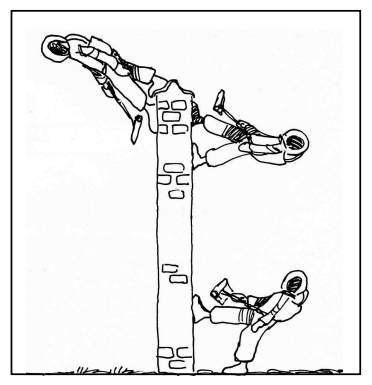
A month after Ann Dolphijn's original sighting, a similar sighting occurred in Vilvoorde, Belgium. In this case, it was a 28-year-old man who, like Ann, got out of bed at night to use the restroom. It was 2:00 a.m., and while walking to the bathroom, he heard strange metallic sounds coming from outside and saw a green glow coming from behind the curtains. He opened his curtains and saw a figure, no taller than a meter, walking through his garden with an instrument that looked like—there it is again—a carpet sweeper.
The similarity ends there, because when the figure realized it was being watched, it turned its entire body (instead of just its head), and the reporter could see nothing more than luminous yellow eyes and what appeared to be pointed ears. The creature also wore a shiny diver's suit, a transparent helmet with a hose extending to a backpack, and a kind of luminous box on its waist. When the figure fled, things got even stranger, because it walked perpendicularly—its body horizontally—up the surrounding wall until it disappeared behind it.
A moment later, a buzzing sound became noticeable, and then a disk with lights and a dome appeared behind the wall, revealing the figure. It swayed upwards and then shot into the night sky, the caller reported.
It should be noted that, unlike Douwe Bosga in the Dolphijn case, the investigator of this Flemish close encounter, Franck Boitte, wasn't so sure. This former employee of SOBEPS (Société Belge d'étude des Phénomènes Spatiaux) conducted a three-hour interview with the reporter in question and concluded that the reporter frequently experienced fantastical perceptions and visions. However, because the reporter didn't want to draw attention to his story and his demeanor seemed genuine—and wasn't even afraid to investigate his psyche further—Boitte believed the case had to remain unexplained. The most plausible explanation he could offer for the event was a realistic dream.
5,000 kilometers away
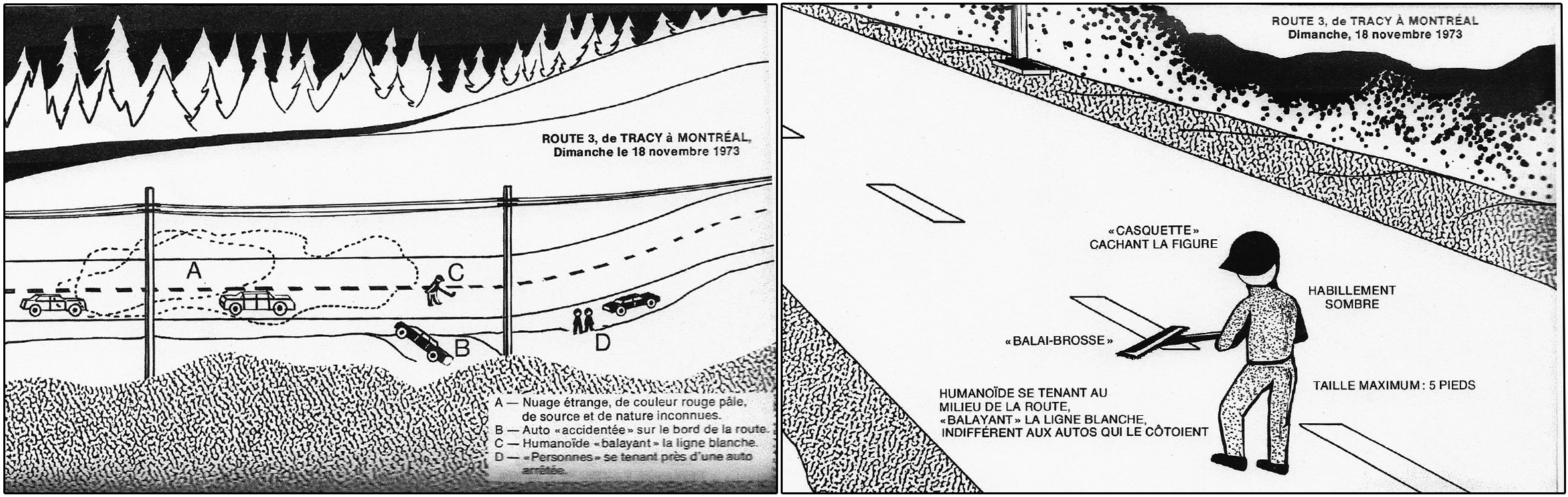
As if the coincidence of the above events wasn't coincidental enough, another similar close encounter occurred in November 1973. This time, not exactly around the corner, but in Quebec, Canada.
On Sunday evening, November 18th, a group of four young women from Sorel-Tracy is driving toward Montreal. Just past Sorel-Tracy, a ball of light appears in the sky ahead of the car. After they overtake it, it continues to follow them until they reach their destination in Montreal. But long before they reach Montreal, they, like other traffic, find themselves driving through a strange pink haze that hangs just above the road. As they emerge from the haze, they see a small man shuffling across the white lines between the lanes. Unhindered by passing traffic, he appears to be clearing the road with something that looks like, yes, a carpet sweeper. Further along the shoulder, a car is parked in a ditch, and a little further on, three people dressed in black are standing next to a parked car.
The story is extensively explored in Claude MacDuff's 1975 book "Le procès des soucoupes volantes" (The Process of Voluntary Sowing) , and is indeed described as extraterrestrial. This is partly because the figure's solitary presence was so unusual. Roadwork is always done in groups, after all. However, the English summary from John Brent's 1979 book , "UFO, Occupants & Critters," takes a more skeptical view of the "Ufonaut." Brent writes that he has regularly seen road workers working alone on highways around Alberta, while their colleagues are working elsewhere. In any case, due to insufficient information about the man, the mysterious pink nebula, and the UFO, the case was never solved.

Chocolate father
The purchase of an assortment of alien knickknacks proved that the little creature with the carpet sweeper had also set foot in Japan, albeit a plastic one. In 2002, toy brand Tomy introduced the Chocovader collectibles ; a series of Pokémon-like creatures, largely based on well-known close encounters. The chocolate-covered toys, available from Japan's popular slot machines ( gachapon ), were later joined by a card game, video games ( arcade and Game Boy Advance ), and an animated series. Our carpet sweeper friend from 1973, of course, had to be included in the series and is therefore seen again with the name Soujiki —Japanese for vacuum cleaner.

Conclusion
Well, you tell me . A year in which hundreds of close encounters were reported worldwide, three of which were very similar within a month, and without the reporters knowing each other's story... Coincidence? Perhaps, but it doesn't feel that way. If it had to smell of anything, I'd describe it as mass hysteria, but as far as I know, these kinds of close encounter stories didn't come to light enough for that, especially in the Netherlands. Moreover, the books " Year of the Humanoids" and "UFO, Occupants & Critters" were n't published until much later.
Moreover, the carpet sweeper is such a specific attribute in these three cases that it's almost impossible to invent it. And again: the explanations mentioned are all very plausible, but they can only answer parts of the mystery. The rest must have been fabricated, but Ann Dolphijn was far too serious, even conservative, and not to mention anonymous for that—her pseudonym in the press was Saskia Vermeulen. I'm using her real name here because she's since passed away and no one can bother her with this story anymore. I also find the testimony more complete and sympathetic with a name.
Anyway, I don't think it was a big joke. I'd sooner put it down to two similar dreams and a road worker... Or is there a possibility that all the alien races—if they're even watching us—have agreed to exclusively use 1973 for some nighttime fieldwork? And why a new housing development in Uden, a backyard in Vilvoorde, and a highway in Quebec? Is there still something precious buried that we don't know about?
We may never get an answer, but this nearly simultaneous triptych is too beautiful and interesting not to share. Please leave your theories on this matter in the comments below. We're very curious.


No comments:
Post a Comment